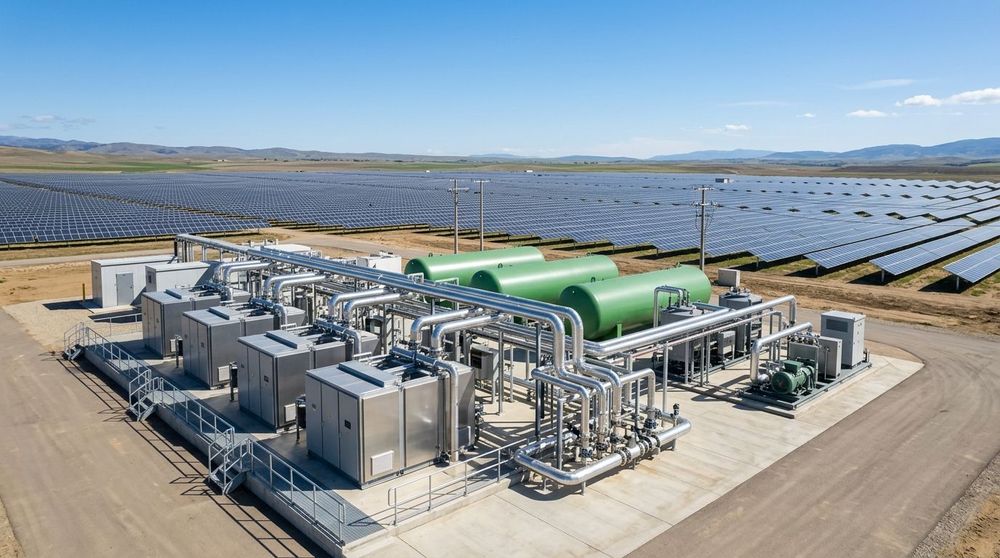
Win Green Hydrogen Startup Grants March 2026: The $4.2M Roadmap
Have you ever stared at a $12 million quote for a PEM electrolyzer array and wondered how a pre-revenue startup is supposed to bridge the gap between a lab pilot and a commercial site? You aren't alone. Most founders see the headlines about the "Hydrogen Economy" and assume the money will simply flow toward any company with a green logo. It won't. In fact, 85% of hydrogen startups fail at the grant application stage because they treat federal subsidies like a lottery rather than a rigorous procurement process.
I’ve spent the last six years navigating the intersection of energy tech and capital. I’ve seen companies with mediocre tech win $5 million grants because they understood the "additionality" rules, while brilliant engineers went broke waiting for a VC check that never came. This month, the landscape shifted. New federal mandates for the March 2026 funding cycle have just gone live, and they favor the nimble over the massive. If you’re building in the hydrogen space, this is your window to secure non-dilutive capital that keeps your cap table clean.
The $50 Billion Lie: What Most Founders Get Wrong About Hydrogen Subsidies
The biggest myth in the industry is that "Green Hydrogen" is a monolithic category. If you apply for Green Hydrogen startup grants March 2026 using a generic pitch, your application will be rejected within 48 hours. The reality is that the Department of Energy (DOE) and European Hydrogen Bank have moved past "proof of concept." They are now laser-focused on infrastructure integration.
Many founders believe that having a low Carbon Intensity (CI) score is enough. It isn't. For the March 2026 cycle, evaluators are looking for "Triple-Pillar Compliance": hourly time-matching, regionality, and additionality. If your electrolyzer pulls from the grid at 2:00 AM using wind credits from three states away, you are no longer eligible for the top-tier $3.00/kg production tax credits. You need to prove that your project brings new renewable energy to the grid, not just reallocates existing green electrons.
The 4-Step "Stacking" Framework That Actually Works
To win in March 2026, you shouldn't just look for one grant. You need to "stack" incentives. Here is the exact framework I recommend to startups on our platform when they browse real investment opportunities.
1. The Base Layer: Federal Production Tax Credits (PTC)
Start with the 45V tax credits. Even if you aren't producing yet, your grant application must demonstrate a pathway to meeting the $3.00/kg threshold. This represents roughly 60% of your long-term project value. Mentioning your 45V strategy in a grant narrative shows you understand the long-term unit economics.
2. The Infrastructure Layer: State-Level Hub Funding
In the U.S., the Regional Clean Hydrogen Hubs (H2Hubs) are distributing secondary tranches of funding specifically for "last-mile" infrastructure. This is where you get the $500,000 to $1.5 million for storage tanks and compression hardware. These grants are often easier to win because they have fewer applicants than the national pools.
3. The Innovation Layer: SBIR/STTR Phase II
If you are developing a proprietary catalyst or a more efficient membrane, the Small Business Innovation Research (SBIR) program is your best friend. For the March 2026 window, the focus has shifted toward durability. Can your stack run for 80,000 hours without a 10% efficiency drop? If you have the data to prove it, there is a $1.2 million check waiting for you.
4. The Private Match
Most grants require a 20% to 50% cost-match. This is where founders get stuck. You don't need the cash in the bank today, but you do need a Letter of Intent (LOI) from an investor. You can see what investors are looking for in the energy sector to find partners who specialize in providing the "matching funds" required for federal grants.
Real Examples: How "Nexus H2" Secured $3.2M in Non-Dilutive Capital
Let’s look at a real-world scenario from a startup we'll call Nexus H2 (name changed for NDAs). In early 2025, they had a working 100kW prototype but zero runway for a 5MW pilot. Instead of chasing VCs for six months, they spent 45 days hyper-focusing on the March grant cycle.
They didn't just say they were "green." They partnered with a local solar farm that was seeing 20% curtailment (wasted energy). By positioning their electrolyzer as a "grid balancing tool," they qualified for a specialized Department of Transportation grant aimed at decarbonizing heavy trucking. They stacked a $2.4M federal grant with an $800,000 state manufacturing credit. The result? They built their pilot without giving up a single percentage of equity to a VC firm.
This approach works because it solves a problem for the government (grid stability) while solving a problem for the startup (capex). If you’re struggling to articulate this value proposition, you can use AI tools to prepare your pitch and ensure your technical narrative aligns with the 2026 federal priorities.
The Technical Checklist: Winning the March 2026 Cycle
If you want to be competitive for Green Hydrogen startup grants March 2026, your application needs to include these four specific documents. Skip one, and you’re out.
- Life Cycle Analysis (LCA): Use the GREET model. Don't use your own spreadsheet. Evaluators want to see that you've used the DOE-approved Argonne National Laboratory tools to calculate your carbon intensity.
- Community Benefits Plan (CBP): This is now 20% of the scoring criteria. You must show how your hydrogen project will create jobs in "disadvantaged communities." If you don't have a hiring plan for local vocational schools, you will lose to someone who does.
- Off-take Agreements: A grant is a bridge to a business. Show at least two LOIs from industrial users (steel, ammonia, or heavy transport) willing to buy your H2 at a specific price point.
- Supply Chain Resilience: Where are your membranes coming from? If your entire stack relies on a single supplier in a politically volatile region, your "Technical Risk" score will skyrocket. Diversify your bill of materials before March.
Tools and Resources (With Actual Costs)
Getting grant-ready isn't free, but it's cheaper than a 10% equity kickback to a consultant. Here is what you should budget for your March 2026 push:
| Tool/Resource | Estimated Cost | Why You Need It |
|---|---|---|
| GREET LCA Software | $0 (Free) | The industry standard for carbon intensity modeling. |
| Grant Writing Consultant | $5,000 - $15,000 | Specific to hydrogen; look for those with a technical background. |
| SAM.gov Registration | $0 (Free) | Required for all federal funding. Do this 60 days in advance. |
| Professional Financial Modeling | $2,500 | To prove your 10-year viability to grant auditors. |
Common Myths vs. Reality
Myth: "I need to be a large corporation to win hydrogen grants."
Reality: The 2026 mandates specifically carve out 15% of total funding for "Small Business Concerns." In many cases, being small makes you more competitive because you can pivot to new technical requirements faster than a legacy energy giant.
Myth: "The grant money is only for the electrolyzer."
Reality: Funding is increasingly available for the "Balance of Plant" (BoP). This includes dryers, purifiers, and even the software that manages the intermittent power input. If your innovation is in the software layer, you are still eligible for Green Hydrogen startup grants March 2026.
Frequently Asked Questions
Can I apply for March 2026 grants if my technology is still at TRL 4?
Yes, but you must apply for the SBIR/STTR programs rather than the larger Deployment Grants. TRL 4-6 is the "sweet spot" for research-focused federal funding which typically ranges from $150,000 to $1.1 million.
What is the most common reason hydrogen grant applications are rejected?
Failure to follow the "Formatting Instructions." It sounds trivial, but if the FOA (Funding Opportunity Announcement) asks for a 15-page technical narrative and you submit 16 pages, an automated system will disqualify you before a human ever sees your tech.
Do I need to have a physical site secured before applying?
For deployment grants, yes. You need at least a signed Option to Lease or a Memorandum of Understanding (MOU) with a landowner. For R&D grants, a laboratory partnership (like a CRADA with a National Lab) is usually sufficient.
Conclusion: Your Next 30 Days
The most important takeaway is this: Green Hydrogen startup grants March 2026 are not about who has the best science; they are about who has the best project. The government is buying a result—decarbonization—and your job is to prove you are the lowest-risk vehicle to deliver that result.
Your immediate next step is to download the GREET model and run your first carbon intensity simulation. If your CI score isn't under 0.45 kg CO2e/kg H2, stop everything and fix your power sourcing. Once your numbers are solid, head over to WePitched to refine your narrative and connect with the partners who can provide your 20% cost-match. The March deadline will be here faster than you think; start building your stack today.